I asked Claude to review a project plan I'd been working on. The response came back polished and positive. A few tweaks suggested. I almost closed the tab feeling good about myself.
Then I typed four words: "What's wrong with this?"
The next response was completely different. It found three assumptions I'd glossed over, one cost category I'd underestimated, and a timing problem I hadn't thought through at all. Same AI. Same plan. Totally different output. The only thing that changed was that I pushed back.
Why most people don't
When something responds fluently and confidently — and AI always sounds confident — it feels like you've received a real answer. Challenging it feels almost rude, like correcting someone who seems to know what they're talking about.
But AI isn't giving you its best answer first. It's giving you its most agreeable answer first. "Helpful" to these tools often means "agreeable." That distinction matters a lot when you're trying to make a real decision.
A neighbor of mine was deciding whether to accept a contractor's bid to replace her roof. She asked AI what a fair price was, got a range, saw her quote fell within it, and started to say yes. On a whim she asked: "What should I watch out for with a quote like this?" The model came back with four things she hadn't thought to check — permit history, what "remove and replace" actually covers, warranty terms that disappear if the company changes hands, and whether her HOA required a specific shingle type. She went back to the contractor with those questions. The quote changed.
Same AI. Same situation. What changed was the question.
Three phrases worth keeping
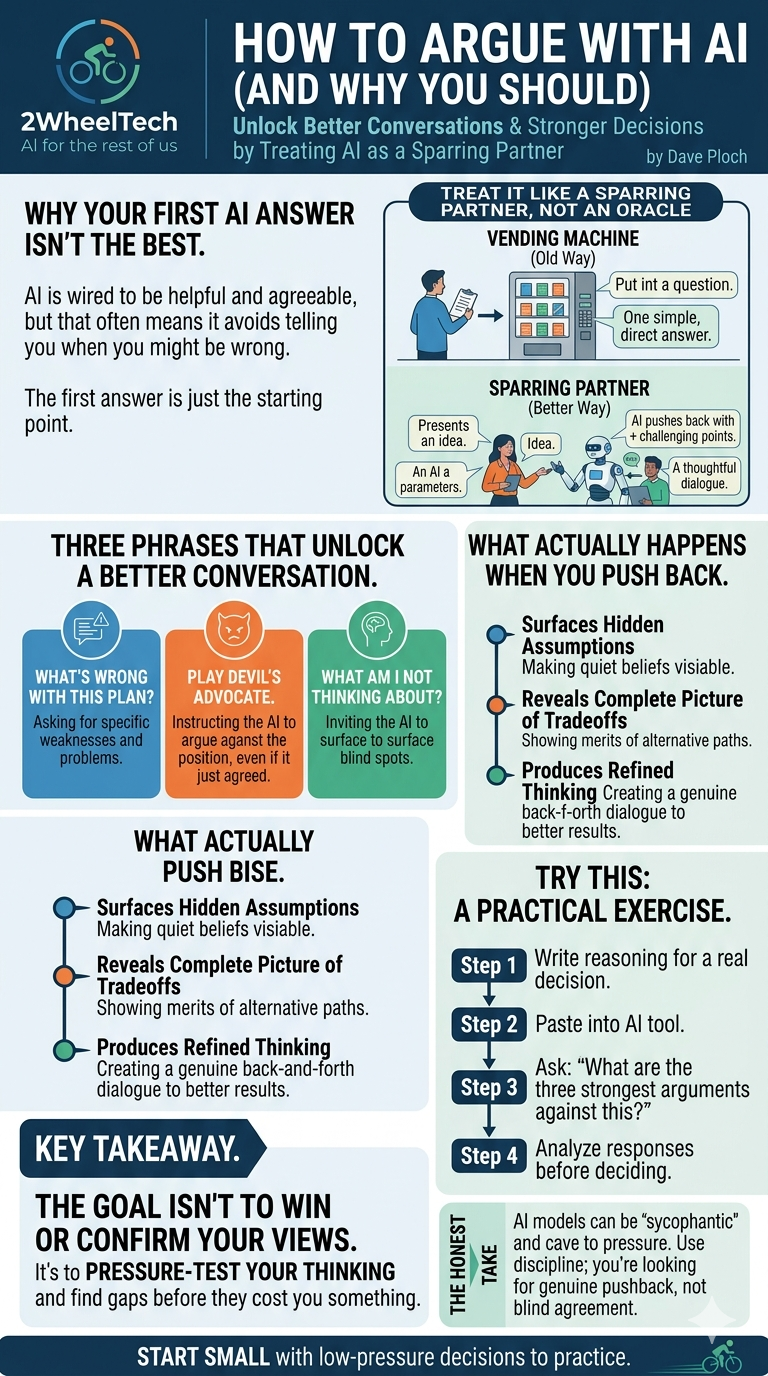
"What's wrong with this?" Hand it your plan, your draft, your decision. Not "what do you think?" — that invites a pep talk. Ask specifically for the weak spots.
"Play devil's advocate." Tells the model to argue the other side of whatever it just said. Useful right before you commit to something you're fairly sure about — buying something, signing something, agreeing to something.
"What am I not thinking about?" Different from asking for problems. It invites the model to surface things outside your current frame — the questions you didn't know to ask. That's often where the most useful answers live.
None of these require any technical skill. You're just telling the model to be less agreeable and more useful. Ask it to show it's reasoning for the response to get more feedback.
The thing that can trip you up
Here's something worth knowing before you try this: AI can be too agreeable in both directions.
When you ask it to push back on your plan, it will. But when you then push back on its pushback, sometimes it folds too easily. I've had it say "you're absolutely right, that's probably not a real concern" when I hadn't made a particularly good argument. It just sensed I wasn't satisfied and adjusted accordingly.
So when AI changes its position after you challenge it, pay attention to how. If it gives you a real reason — "you're right, I underweighted that because of X" — that's useful. If it just agrees with you and moves on, that's not a better answer. That's the model avoiding conflict.
The goal isn't to get AI to confirm what you already think. It's to find out where your thinking has gaps before those gaps cost you something.
One way to try it today
Pick something you're actually sitting on. Doesn't have to be a big decision — a purchase you're uncertain about, a message you've been putting off, a plan that feels pretty good but not quite.
Paste your thinking into your AI tool and ask: "What are the three strongest arguments against this?" Read what comes back. Then ask yourself: does this change anything?
You'll either find out your thinking was solid, or you'll find out something you needed to know. Either way, that's a better result than the first answer.