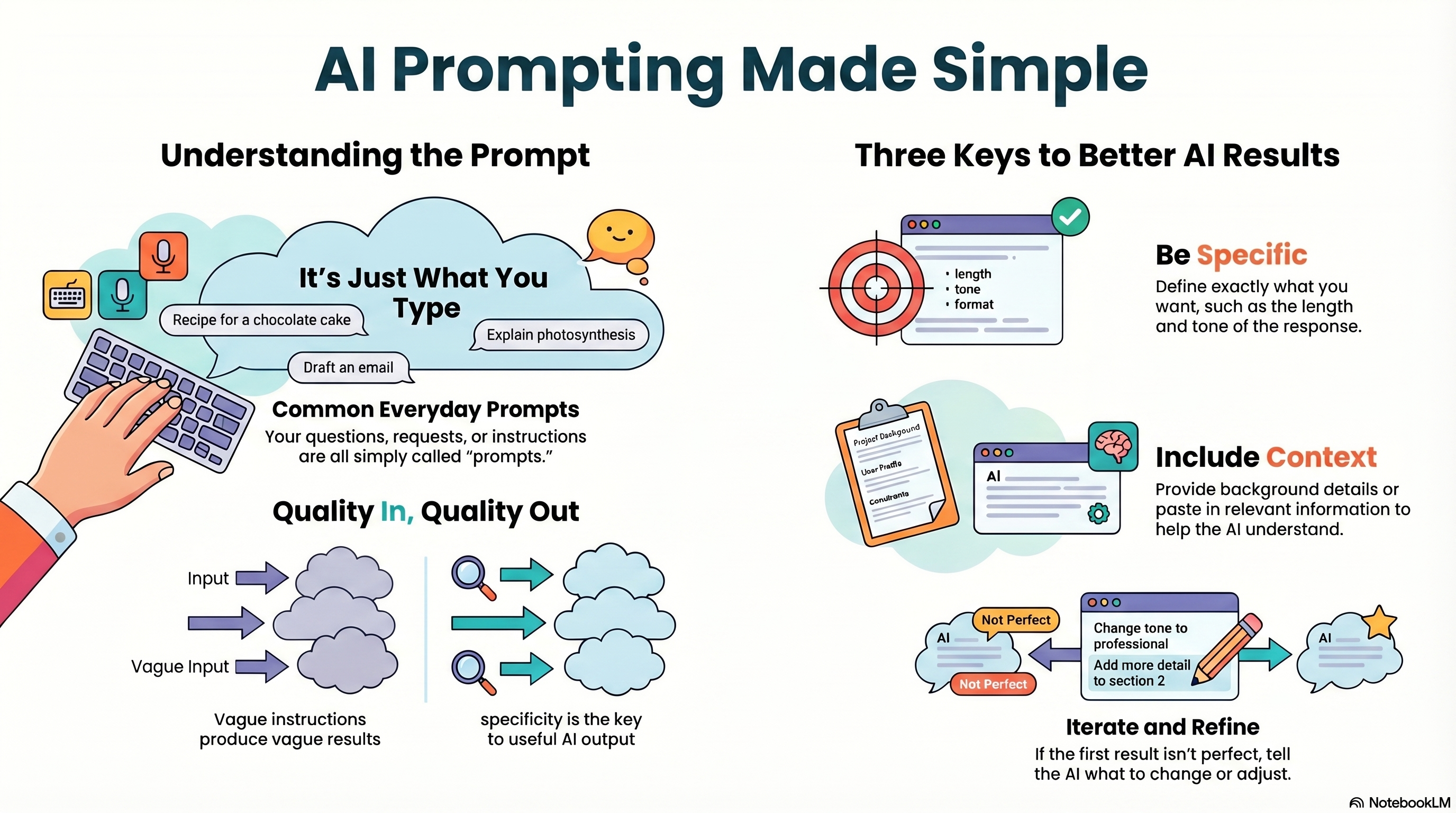
You've probably noticed that "prompt" has become one of those words that tech people throw around constantly, and nobody stops to explain what it means.
If you've used ChatGPT, Google Gemini, or any AI assistant, you've already written hundreds of prompts — you just didn't know that's what they were called. A prompt is simply what you type into an AI tool. That's it. Every question you ask, every instruction you give, every message you send — that's a prompt.
A prompt is the message you type to an AI. Whatever you write in that chat box before you hit send — that's your prompt.
Here's a useful way to think about it. Imagine you've just hired a very capable assistant who is starting their first day. They're smart, they're willing, and they can handle almost anything — but they don't know you yet. They don't know what you care about, how you like things done, or what you're trying to accomplish. So the quality of their work depends almost entirely on how well you explain the task.
A vague prompt gets a vague answer. "Write me something about dogs" will get you a generic few paragraphs about dogs. But "Write a short, funny birthday message for my 8-year-old nephew who loves golden retrievers and Minecraft" — that gets you something actually useful.
That's the whole insight behind "prompt engineering," another term you may have heard. Despite the fancy name, it just means getting better at explaining what you want. The better you describe the context, the tone, and the goal, the better the result. No technical skills required — just clearer thinking.
So next time someone mentions prompts, you can nod along — because you've been writing them this whole time. The only question is how good they are.